Xinhua
19 Feb 2026, 07:15 GMT+10
by Xinhua writers Xiong Wenyuan, Xu Haijing
MELBOURNE, Feb. 19 (Xinhua) -- In a narrow laneway off Melbourne's Chinatown, the Museum of Chinese Australian History stands behind a vermilion door with a brass pull-ring -- understated at first glance, yet expansive in historical scope.
Inside, folding screens, Spring Festival couplets and the Chinese character "fu" share space with exhibitions that trace the long, layered journey of Chinese Australians.
For Mark Wang, the museum's chief executive officer, it is both a public institution and his life's mission.
A fifth-generation Chinese Australian whose ancestors came from south China's Guangdong Province, Wang helped establish the museum in the 1980s and has devoted decades to building it into a cultural and historical archive.
What began as an effort to house a giant dragon brought from Foshan, Guangdong, has evolved into a multi-level narrative of migration, hardship, adaptation and contribution.
On a recent guided tour, Wang led visitors through the museum's key exhibitions in sequence -- from "One Million Stories" on the third floor to the immersive "Finding Gold" space in the basement, and finally to the Dragon Gallery on the ground floor, where ritual, memory and community life converge.
"One Million Stories: Chinese Australians 200 Years" maps a broad arc from 1818, identified by the museum as the year of the first Chinese arrival in Australia, to 2018, when the Chinese Australian population reached one million.
The exhibition follows major phases of Chinese migration and settlement. According to Wang, contemporary Chinese-Australian demographics were shaped by three major waves: arrivals during the 1850s gold rush, migration from Southeast Asia in the 1970s, and migration linked to China's reform and opening-up from the 1980s onward.
Its curation moves between broader historical forces and lived experience. Archival objects -- from period garments to Chinese-made furniture -- show how migrants did more than seek work: they built families, businesses, social networks and enduring community culture.
Wang described Melbourne's Chinese name, "New Gold Mountain," as a historical echo of the gold-rush era, when large numbers of Chinese miners arrived in search of opportunity and many later settled permanently.
The gallery also confronts the harsher chapters: anti-Chinese discrimination and exclusionary policies that cast long social and legal shadows. For Wang, this is indispensable to the story. It explains both the barriers Chinese communities faced and the resilience they forged over generations.
He noted that Chinese Australians contributed far beyond the mines -- through small business, agriculture, wartime service, sports and charitable work -- and gradually became an integral part of Australian society.
Today, many Chinese Australians have entered professions their forebears could scarcely have imagined, as economic and cultural links between Australia and China continue to deepen.
The year 2025 marked the 10th anniversary of the China-Australia Free Trade Agreement, with bilateral trade exceeding 300 billion Australian dollars. China has remained Australia's largest trading partner for 16 consecutive years.
From the third floor's sweeping historical arc, the tour descends into "Finding Gold: Chinese on the Goldfields of 19th Century Australia," an immersive reconstruction of early migrant experience.
It begins with a shipboard scene of the voyage from Hong Kong to Australia. Wang said the journey could take around 60 days, often in cramped conditions, before migrants reached Australian shores.
He also noted that colonial Victoria imposed extra burdens on Chinese arrivals, including a 10-pound tax. To avoid the levy, many landed in neighboring South Australia, where the charge did not apply, and then traveled long distances overland to the Victorian goldfields.
Mining tools such as pans and cradles, together with displays of water-channeling methods, reveal the practical techniques Chinese miners used. Wang said Chinese teams were often highly organized and efficient -- productivity that also stirred resentment in fiercely competitive mining zones.
The reconstructed goldfields environment also emphasizes life beyond extraction: migrants grew vegetables and grain, opened shops and eateries, established clan and temple spaces, hosted Cantonese opera performances, and developed social practices that sustained community life under difficult conditions.
The final stop is the Dragon Gallery, home to one of the museum's most recognizable symbols.
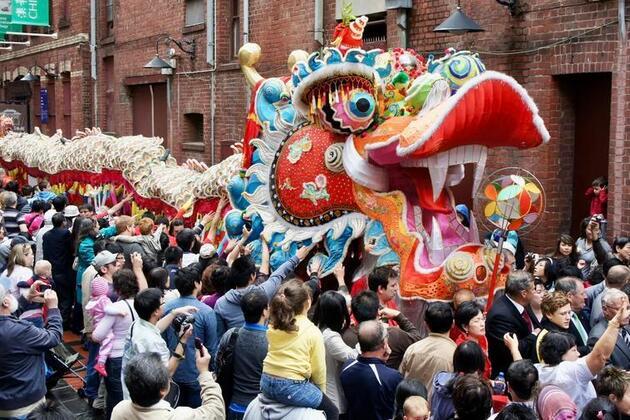
A 63-meter dragon coils through the exhibition hall. Three generations of dragons appear in the museum's narrative: the earliest has retired, while the third-generation Millennium Dragon now carries performance duties.
Each Chinese New Year, Wang said, the dragon returns to Melbourne's Chinatown streets with lion dance teams, lantern groups and a large procession of more than 100 participants.
In this tradition, the dragon symbolizes water, renewal, agricultural blessing and new beginnings. Parade imagery may include mythical creatures such as the phoenix, as well as references to heaven, earth, sun and moon -- expressing an ideal of harmony among all beings.
Displayed nearby, the dragon head blends features from multiple animals. For Wang, that composite form reflects the layered identity -- and gradual integration -- of diasporic communities in multicultural societies.
Beyond the museum walls, this long history continues to shape contemporary ties between Australia and China.
In 2025, more than 400,000 Chinese tourists visited Victoria. For many of them, this museum of memory offers not only a better understanding of Chinese Australian history, but also a clearer view of the communities helping shape contemporary Australia.
In a city where Chinatown is often captured in festival snapshots, the museum invites a slower reading -- one that sees not only symbols, but the people, histories and generations behind them.
Behind an unassuming laneway door, that long story continues: not only as remembrance, but as part of an evolving relationship across communities, cities and countries.
Get a daily dose of Australian Herald news through our daily email, its complimentary and keeps you fully up to date with world and business news as well.
Publish news of your business, community or sports group, personnel appointments, major event and more by submitting a news release to Australian Herald.
More InformationDHAKA, Bangladesh: After securing an emphatic win for his Bangladesh Nationalist Party, the country's future prime minister, Tarique...
WASHINGTON, D.C.: Adding to the list of legal battles challenging U.S. President Donald Trump's effort to stamp his name on public...
BEIJING, China: ByteDance said it would strengthen safeguards on its AI video generator Seedance 2.0 to prevent the unauthorised use...
ISLAMABAD, Pakistan: Days after Pakistan's Supreme Court ordered a medical evaluation of incarcerated former prime minister Imran Khan...
A Life of Purpose Ends Peacefully The news rippled across the nation on a quiet Tuesday morning in February—the Rev. Jesse Louis Jackson...
MALAKOFF, Texas: Numerous social media posts linking a billionaire with ties to Jeffrey Epstein to the photography giant Lifetouch...
SYDNEY, NSW, Australia - New Coalition Leader Angus Taylor has led the Liberal-National Coalition back in front of One Nation on his...
by Xinhua writers Xiong Wenyuan, Xu Haijing MELBOURNE, Feb. 19 (Xinhua) -- In a narrow laneway off Melbourne's Chinatown, the Museum...
Canberra [Australia], February 19 (ANI): Chief of Army Staff General Upendra Dwivedi discussed bilateral defence cooperation with Australian...
New Delhi [India], February 19 (ANI): Indian men's hockey forward Angad Bir Singh has been named in the 24-member Indian squad for...
New Delhi [India], February 18 (ANI): Former Australian legend Ricky Ponting spoke about the future of Australia's T20 team, with the...
New Delhi [India], February 18 (ANI): Following Australia's shocking T20 World Cup group stage exit, former Australian skipper Ricky...