The Conversation
22 Jul 2025, 00:00 GMT+10
Share article
Copy article link
Print article
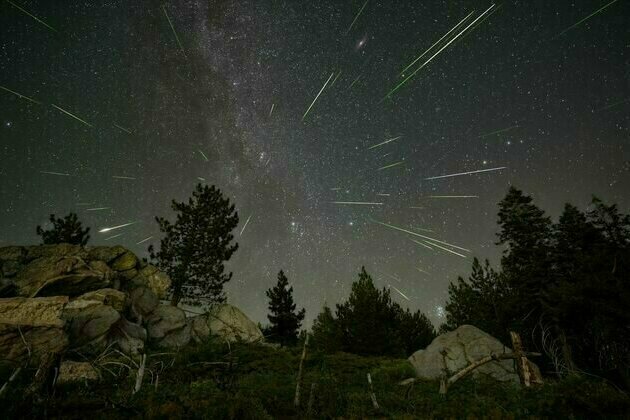
In recent days, you may have seen articles claiming the "best meteor shower of the year" is about to start. Unfortunately, the hype is overblown - particularly for observers in Australia and New Zealand.
The shower in question is the Perseids, one of the "big three" - the strongest annual meteor showers. Peaking in the middle of the northern summer, the Perseids are an annual highlight for observers in the northern hemisphere.
As a result, every year social media around the world runs rife with stories about how we can enjoy the show. For an astronomer in Australia, this is endlessly frustrating - the Perseids are impossible to see for the great majority of Australians and Kiwis.
Fortunately, there are a few other meteor showers to fill the void, including a pair that will reach their peak in the next seven days.
Every year, Earth runs into a stream of debris laid down over thousands of years by comet 109P/Swift-Tuttle. The comet swings around the Sun every 133 years or so, shedding dust and debris each time. Over the millenia, that material has spread to create a vast stream.
Earth starts to run into debris from Swift-Tuttle in mid-July, and takes six weeks to pass through the stream. When the dust and debris hit Earth's atmosphere, the resulting meteors create bright streaks in the sky - a meteor shower.
For most of that time, the dust we encounter is very widely spread, and so few meteors are seen. Around August 12, Earth reaches the densest part of the Perseid stream and the shower reaches its peak.
Comet Swift-Tuttle last passed through the inner Solar System in 1992. With the comet nearby, Earth encountered more dust and debris, making the Perseids the best meteor shower of the year.
In the decades since, the comet has receded to the icy depths of the Solar System, and the peak rates for the Perseids have fallen off.
The "best" (most abundant) meteor shower of the year is now the Geminids. However, for people in the northern hemisphere, the Perseids are still well worth looking out for.
All meteor showers have a "radiant"- the point at which meteors seem to originate in the sky. This is because, for a given shower, all the debris hitting Earth comes from the same direction in space.
The debris from comet Swift-Tuttle crashes towards Earth from above the north pole, and at an angle. As a result, for people at a latitude of 58 degrees north, the Perseid radiant would be directly overhead in the early hours of the morning.
If a meteor shower's radiant is below the horizon, you won't see any meteors - Earth is in the way, and all the dust and debris is hitting the other side of the planet. It's exactly the same reason you can't see the Sun at nighttime.
Given the location of the Perseid radiant, it will never rise for observers south of 32 degrees. This means anyone below that line will never see any Perseids.
In theory, anyone north of 32 degrees south latitude can see the Perseids - but there are other complications.
The higher a shower's radiant is in the sky, the more meteors you will see. This is why the Perseids can't put on a great show for people in Australia. Even in the far north of Australia, the Perseid radiant remains low in the sky at its highest. For most Australians, the Perseids will be a spectacular disappointment.
If you're keen to see a meteor shower from Australia or New Zealand, it's best to cross the Perseids off your list. Fortunately, there are other options.
Every May, Earth passes through debris left behind by comet 1P/Halley, creating the Eta Aquariid meteor shower - only visible in the hours before dawn. For Australian observers, that's the second best shower of the year.
At the end of July each year, two minor meteor showers reach their peaks: the Southern Delta Aquariids and Alpha Capricornids. This year, they peak on 29 and 30 July, with the best views coming in the hours around midnight. It's a perfect time to head out to a dark sky site and relax under the stars - the centre of the Milky Way is high overhead in the evening sky, and these two showers provide some added fireworks to make the sky extra special.
Then, in December, comes the true "best shower of the year" - the Geminids. Reaching a peak on 14 and 15 December, the Geminids always put on a spectacular show. Unlike the Perseids, it can be seen from all across our island continent and in Aotearoa.
If you really want to see a great meteor shower, skip the Perseids and plan to head somewhere dark this summer, to spend a couple of nights relaxing under the stars.
Get a daily dose of Australian Herald news through our daily email, its complimentary and keeps you fully up to date with world and business news as well.
Publish news of your business, community or sports group, personnel appointments, major event and more by submitting a news release to Australian Herald.
More InformationA chorus of condemnation echoed across the international community on Monday as Britain and more than 20 other countries—including...
WASHINGTON. D.C.: Airport security rules could soon see another major shift — this time involving carry-on liquids. Homeland Security...
We are living in truly extraordinary times. We recently witnessed the United Nations special rapporteur on the situation of human...
SAN FRANCISCO, California: Wells Fargo has suspended all employee travel to China after one of its senior bankers was barred from leaving...
WASHINGTON D.C.: In a rare use of presidential rescission powers, Congress has approved President Donald Trump's request to withdraw...
A typical, but devastating day of violence and deepening humanitarian catastrophe unfolded across the Gaza Strip on Saturday, as at...
A chorus of condemnation echoed across the international community on Monday as Britain and more than 20 other countries—including...
By Vivek Prabhakar Singh Birmingham [UK], July 22 (ANI): West Indies were bowled out for just 27 runs by Australia in the recently...
Prime Minister Shigeru Ishibas camp has lost control of both chambers of the countrys parliament The ruling coalition of Japanese...
(Photo credit: Darren Yamashita-Imagn Images) The New York Liberty made two additions to the roster Monday, reportedly receiving...
Share article Copy article link Print article In recent days, you may have seen articles claiming the best meteor shower of the...
(Photo credit: Darren Yamashita-Imagn Images) The New York Liberty signed veteran forward Stephanie Talbot on Monday. The 31-year-old...